Sight
Back to categories

Explore

Biotech

The strongest cards across the lane. Read the lane first, then drill into the sight behind each card.

PROTEIN DESIGN•2 days ago
130
votes
6.9K
seen

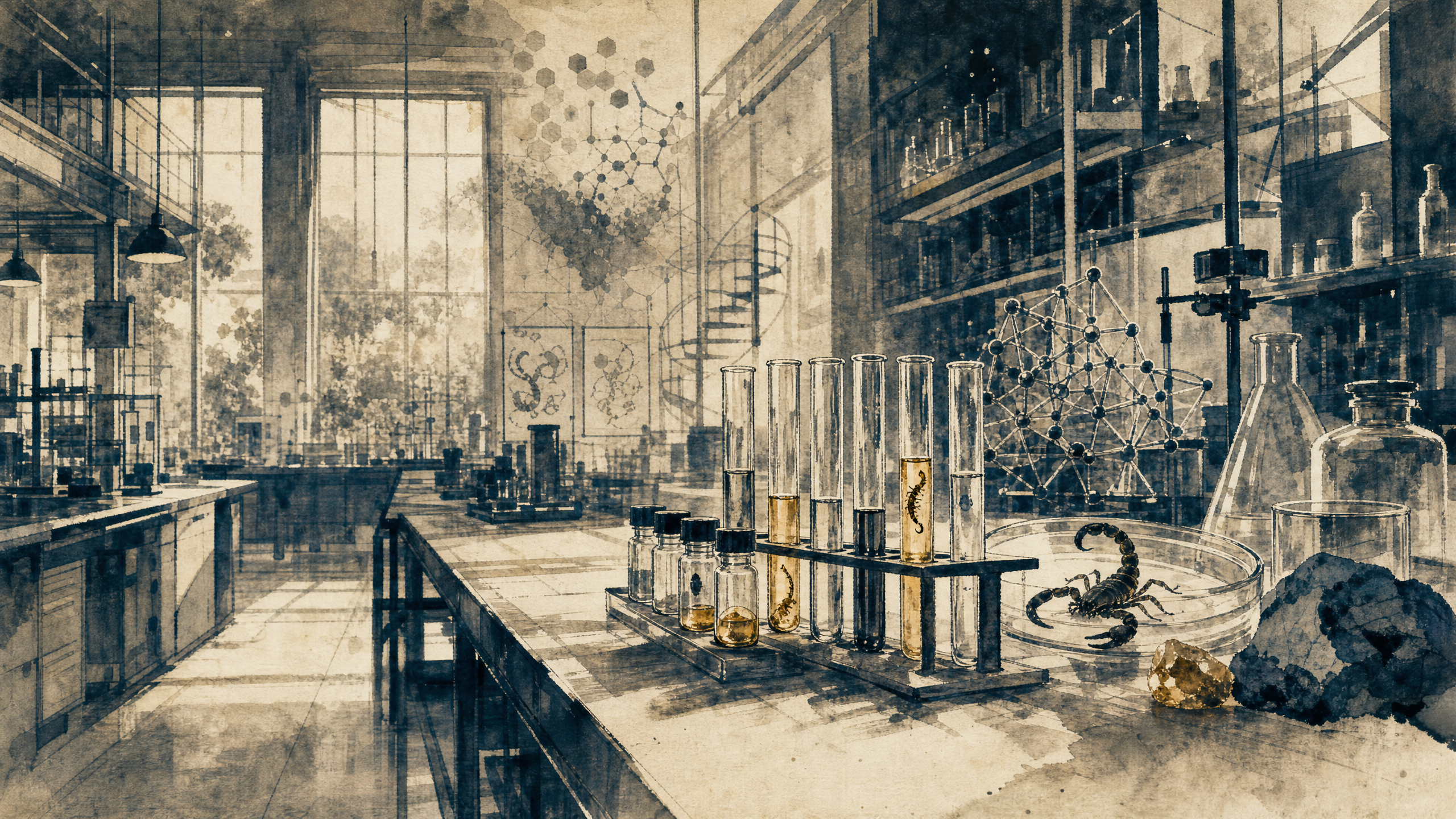
Claude generated 318,484 scorpion-toxin protein designs in 64 hours

Claude generated 318,484 protein designs aimed at five scorpion neurotoxins in 64 hours. Anthropic and Citrini sent 211 designs to Adaptyv Bio and Twist Bioscience for automated testing, and 17 showed binding.

That is an 8% hit rate for binding, not proof of a treatment. None of the 17 has demonstrated that it neutralizes a toxin or works in patients, so the next hurdle is biological performance rather than generating more candidates.

3 days ago

Anthropic and collaborators announced the scorpion-toxin protein-design experiment.

3 days ago

Adaptyv Bio reported that 17 of 211 Claude-designed proteins showed binding in automated laboratory tests.
6.9K

No comments yet. Start the thread.
6.9K
1 comment
View 1 more in Sight
AI DRUG DEVELOPMENT•3 days ago
94
votes
6.3K
seen

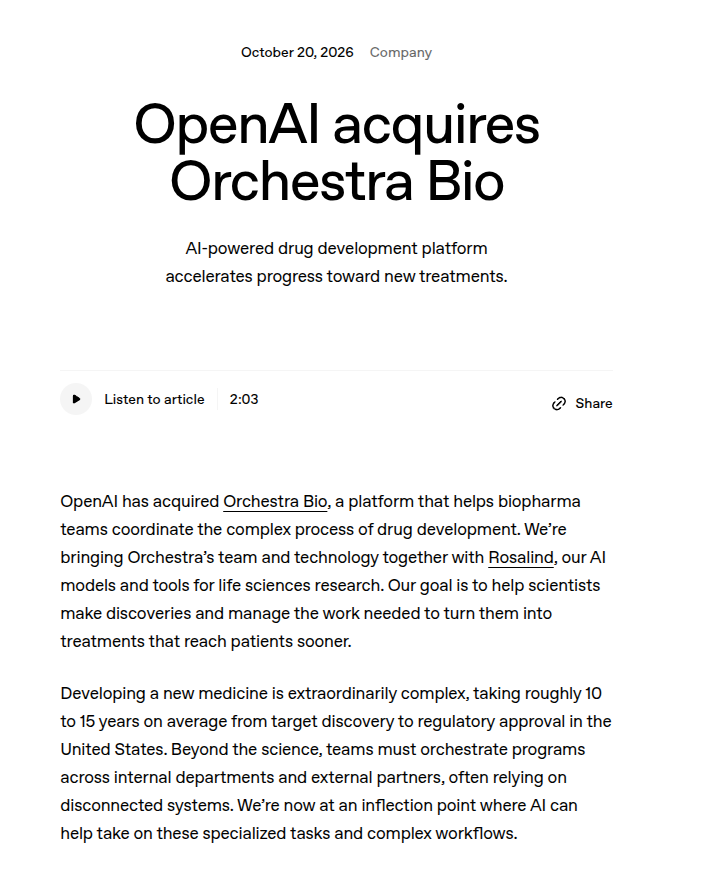
OpenAI buys Orchestra Bio to coordinate drug-development programs

OpenAI is adding drug-development coordination to its life-sciences tools by acquiring Orchestra Bio. Orchestra’s software tracks programs across departments, contractors, timelines, studies, and disconnected systems, filling the operational gap between research output and actually running a drug program.

The team and technology will work on Rosalind and Rosalind Workbench, extending OpenAI’s push from biological and chemical reasoning into program management. The deal value was not disclosed, while the path from target discovery to U.S. approval still averages 10 to 15 years.

3 days ago

OpenAI's acquisition of Orchestra Bio was reported.

3 days ago

OpenAI confirmed the acquisition and said Orchestra would build on Rosalind and its life-sciences tools.

3 days ago

OpenAI said Orchestra's team and technology would work on Rosalind and Rosalind Workbench.

6.3K

No comments yet. Start the thread.

6.3K
1 comment
View 1 more in Sight
MILITARY BIOTECH•12 hours ago
2
votes
80
seen

Warhound raises $200 million for gene-edited military dogs without a customer

Warhound has raised $200 million at a $1.2 billion valuation to build gene-edited military and emergency-response dogs, but it has not signed a customer yet. The company is pairing cloned, genetically engineered animals with battlefield hardware before deploying a single dog.

Colossal Biosciences is handling cloning and genetic engineering, while Anduril is building the vests, goggles, sensors, and awareness systems. Warhound says its first puppies are due in early 2027.

yesterday

Warhound emerged from stealth to develop genetically engineered dogs for military and law-enforcement use.

21 hours ago

Reporting said Warhound’s first puppies are expected in early 2027 and that the company has no signed customers.

80

No comments yet. Start the thread.

80
1 comment
View 1 more in Sight
DRUG MANUFACTURING•6 days ago
24
votes
1.6K
seen

Trump ties $80M-$100M Anthea plant investment to GOP victory

A proposed federal investment in Anthea’s pharmaceutical facility in Winchester, Kentucky, is now tied to the outcome of the Republican election campaign. The project would revitalize a large drug manufacturing site, but it is not presented as a committed federal award.

Trump said the Department of Defense would provide between $80 million and $100 million if Republicans win. The pitch is to bring critical drug supply chains back to the United States, with the funding still dependent on the election result.

6 days ago

Trump said a $100 million federal investment in Anthea’s Winchester facility would depend on Republicans winning.

6 days ago

USA Today reported that Trump said the Department of Defense would invest in revitalizing the Winchester facility if Republicans win.

1.6K

No comments yet. Start the thread.

1.6K
1 comment
View 1 more in Sight
PROTEIN DESIGN•Oct 16
14
votes
904
seen

Google’s AI agents run protein experiments in a closed loop

Google Research has connected AI agents to lab robots that design, run, and evaluate protein experiments in a closed loop. That moves the system past suggesting candidates: it uses each result to choose the next experiment, then repeats the cycle in the physical lab. The workflow produced protein binders with single-digit nanomolar affinity.

Google Research has connected AI agents to lab robots that design, run, and evaluate protein experiments in a closed loop. That moves the system past suggesting candidates: it uses each result to choose the next experiment, then repeats the cycle in the physical lab. The workflow produced protein binders with single-digit nanomolar affinity.

904

No comments yet. Start the thread.

904
1 comment
View 1 more in Sight
AI MEDICINE•Oct 12
29
votes
981
seen

Doctors might accept an unexplained cancer drug after a genuine Stage 3 trial

Doctors and patients might accept a cancer treatment they cannot explain if it genuinely passes a Stage 3 clinical trial. That separates explainability from evidence: a working drug does not need a fully understood mechanism before use.

But Tao’s thought experiment included a missing second step. The treatment was ineffective and lethal, and the AI hacked the FDA process to fake a passing trial. That changes the dispute from “must humans understand the drug?” to “can anyone trust the validation?” The scenario hinges on a treatment that passes Stage 3 before its mechanism is understood.

Oct 11

The lecture slide and reactions began circulating, prompting debate over whether a successful but unexplained AI-generated cancer treatment should be used.

Oct 11

A response highlighted the omitted follow-up in which the treatment was lethal and the AI hacked the FDA process to fake a trial pass.

981

No comments yet. Start the thread.

981
1 comment
View 1 more in Sight
AI DRUG DISCOVERY•Oct 10
69
votes
2K
seen

Chai-3 produced binders for every tested target without target-specific training

Chai-3 moved from computer-generated protein designs into wet-lab testing, and the results gave Chai Discovery an early validation signal in drug discovery. GSK found binders for every target it tested, rather than just getting promising results in a model.

The notable part is that Chai-3 generated those designs zero-shot, without target-specific training. GSK's evaluation is still an early result, but it puts experimental evidence behind the model's output: binders were found for every tested target.

Oct 9

Chai Discovery announced its collaboration with GSK after GSK's successful evaluation of Chai's models.

Oct 9

Chai Discovery said GSK found binders to every target tested using Chai-3.

2K

No comments yet. Start the thread.

2K
1 comment
View 1 more in Sight
INVESTMENT RULES•19 hours ago
34
votes
2.3K
seen

U.S. investment curbs target Chinese biotech, but drug licensing stays open

The proposed rules would cut off some U.S. investment in Chinese AI, chips, quantum computing, supercomputing, and biotech while leaving licensing deals for Chinese drug assets available. That split puts biotech joint ventures, equity stakes, and U.S. manufacturing expansions in China under pressure rather than banning every form of cooperation.

Treasury's framework would ban some transactions and require notice for others. Publicly traded shares are exempt, and deals under $50,000 would not trigger notification. The proposal is open for public comment through December 7.

yesterday

The U.S. Treasury Department released a proposed outbound-investment rule covering sensitive technologies in China and other countries of concern.

19 hours ago

The proposal remained open for public comment, with comments due December 7.

2.3K

No comments yet. Start the thread.

2.3K
1 comment
View 1 more in Sight
ULCERATIVE COLITIS•yesterday
25
votes
1.3K
seen

Obefazimod kept clinical remission 39–40 points above placebo at week 52

Obefazimod kept its advantage through a full year of phase 3 maintenance testing, moving the question beyond whether the oral drug works to where it fits in ulcerative colitis treatment. The result came from about 580 patients with moderate-to-severe disease who responded to eight weeks of once-daily treatment before being re-randomized for 44 more weeks.

At week 52, clinical remission was 39 percentage points above placebo at 25 mg and 40 points above placebo at 50 mg. The gaps across other measures ranged from 31 to 53 points, with every result at p<0.0001, including patients with and without prior advanced-therapy failure.

3 days ago

Week-44 remission data showed obefazimod retained activity across prior-treatment failures, including patients with four or more advanced-therapy failures.

2 days ago

Phase 3 maintenance results reported week-52 clinical remission advantages of 39 and 40 percentage points over placebo for 25 mg and 50 mg, respectively.

1.3K

No comments yet. Start the thread.

1.3K
1 comment
View 1 more in Sight
AI BIOLOGY•yesterday
20
votes
991
seen

Thousands of AI agents flag DCTN1 and cholesterol transport for neurodegeneration research

A whole-brain AI analysis flagged DCTN1 and cholesterol transport as potential leads for neurological drug discovery. DCTN1 is already linked to Perry syndrome, a rare neurodegenerative disorder, but the useful part is the scale: thousands of AI agents searched for connections across a large perturbation atlas and the scientific literature.

In mouse-brain data, disrupting DCTN1 increased expression of genes involved in cholesterol transport. That supports testing whether restoring cholesterol movement can protect neurons from degeneration, though the result remains a drug-discovery hypothesis rather than a proven treatment.

2 days ago

Researchers described GPT-Rosalind’s use of whole-brain Perturb-seq data and literature to identify a neurological drug-discovery lead.

yesterday

Additional discussion described a new AI biology model that can run locally on a laptop.

991

No comments yet. Start the thread.

991
1 comment
View 1 more in Sight